How to Analyze FIFA September 2026 Betting Odds: Key Factors to Consider
Last weekend, a striker was still a regular starter in his domestic league; a few days later, he had to travel across multiple time zones to join his national team. On the betting board, his reputation may still be enough to attract players to the favorite. However, off the pitch, his fitness, tactical role, and even the number of minutes he is expected to play may be very different from what viewers had just seen at club level. This is why analyzing FIFA September betting odds is often more difficult than it initially appears.
The international break at the end of September 2026 also has some distinctive characteristics. Many national teams have just come through the 2026 World Cup and are beginning a new cycle with changes in personnel, coaching staff, or objectives. In Europe, the UEFA Nations League provides clearly competitive fixtures; in other regions, the schedule may include qualifiers, regional Nations League matches, or friendlies. The same formula cannot be applied to every match.
Players should analyze a match through four layers: the nature of the competition, squad stability, the burden of travel, and market reaction. The handicap is only the final result of the pricing process; it is not a guarantee that a famous team will win by a large margin. When information is still incomplete or the odds have already moved too far, staying out can also be the right decision.
Key Points to Remember
- FIFA Days in September 2026 take place immediately after the World Cup, so older data should be given less weight; many teams are undergoing restructuring.
- Official competitive matches must be distinguished from friendlies. The same two teams can have very different motivations, substitution policies, and approaches to managing player fitness.
- A squad list alone is not enough. The starting lineup, player roles, and rotation plans have a more direct impact on the odds.
- A team with many star players is not automatically the better betting side, especially when the handicap reflects the effect of reputation too strongly.
- Live betting should only be used to verify an assessment based on what is happening in the match, not as a tool for chasing previous losses.
- No bet size can turn an assessment based on insufficient data into a safe choice. A bankroll limit should be established before the match begins.
How Are FIFA Days in September 2026 Different from a Domestic League Round?
The biggest difference lies in stability. Clubs work with their players almost every day, while national teams have only a short period together to integrate players from different tactical systems. A national team may have superior individual quality because of its many star players, yet still struggle to build up play, maintain compact distances between players, or coordinate its pressing effectively.
With the 2026 schedule, players must also consider the impact of the World Cup, which has just ended during the summer. Some key players have gone through a long tournament, returned to their clubs after a short break, and then immediately joined their national teams again. Conversely, players who had limited involvement at the World Cup may enter the international break with greater motivation to prove themselves. Fitness and motivation do not necessarily follow reputation.
In Europe, UEFA's official schedule has placed the 2026/27 UEFA Nations League fixtures in the calendar for late September. These are matches with points at stake and specific competitive objectives. However, FIFA Days should not all be grouped under the single label of "national team matches." Each federation has its own schedule, and a team may view its first match as an opportunity to experiment while placing greater emphasis on the following fixture.
|
Factor |
Domestic League |
FIFA Days in September 2026 |
Impact on Odds Analysis |
|
Training time |
Continuous and stable |
Short, with some players joining late |
Increases the risk of a lack of coordination |
|
Data quality |
Many matches played close together |
Limited samples that can become outdated quickly |
Past head-to-head records should not be heavily relied upon |
|
Travel |
Generally more familiar |
May involve crossing multiple time zones |
Flight schedules and recovery time need to be checked |
|
Motivation |
Linked to the entire season |
Depends on whether the match is competitive or a friendly |
Influences how heavily key players are used |
|
Rotation |
Easier to predict |
Changes according to the objectives of the international break |
Waiting for the lineup may be more valuable than betting early |
If you need to place FIFA Days within a broader long-term context, the article on the road to the 2030 World Cup qualifiers helps distinguish which matches are part of a new cycle and which are simply short-term experiments. This distinction is more important than remembering numerous head-to-head results from many years ago.
Why Can 2026 World Cup Data Easily Lead Players to Misjudge the Odds?
The World Cup is the most recent and emotionally engaging source of data, but it is not always the data with the strongest predictive value. A team that advanced deep into the tournament may enter September with a new coach, missing several key players, or shifting from a title-chasing mindset to rebuilding its squad. A team that disappointed at the World Cup may also respond strongly by using a younger core and adopting a more direct style of play.
A common mistake is to use a team's final World Cup position as a fixed benchmark. In reality, a short tournament can be heavily influenced by the draw, timing of form, injuries, and a few decisive moments. When teams return for FIFA Days, the context has changed. A team that previously defended deep during the knockout stage may take more initiative in possession against a weaker opponent; therefore, statistics for shots, possession, or goals may no longer carry the same meaning.
Players should separate the data into two groups. The first consists of relatively sustainable factors, such as defensive structure, ability to defend crosses, and the quality of build-up play from the back. The second consists of results that can be heavily influenced by circumstances, such as short winning streaks, unusually high chance-conversion rates, or performances against opponents with completely different playing styles.
|
Post-World Cup Data |
Keep Weight |
Reduce Weight |
Reason |
|
Tactical framework remains in place |
High |
|
It may continue to shape how the team operates |
|
Individual win or loss results |
|
High |
Small samples can easily be masked by the final score |
|
Key player's role remains unchanged and they are still called up |
Medium to high |
|
Their condition and expected playing time still need to be confirmed |
|
Head-to-head record from many years ago |
|
High |
Players and coaches may have changed |
|
Ability to create chances against similar opponents |
High |
|
Directly relevant to the tactical matchup |
|
Sudden increase in scoring rate over a few matches |
|
High |
It may not be repeated when finishing returns to a normal level |
A balanced approach is to use the World Cup as a starting point, then update your assessment with what has happened at the beginning of the club season and the latest national-team call-ups. The article on lessons from analyzing the 2026 World Cup odds is also useful for reviewing cases where a team won the match but failed to cover the handicap, or played well without producing the result the market expected.
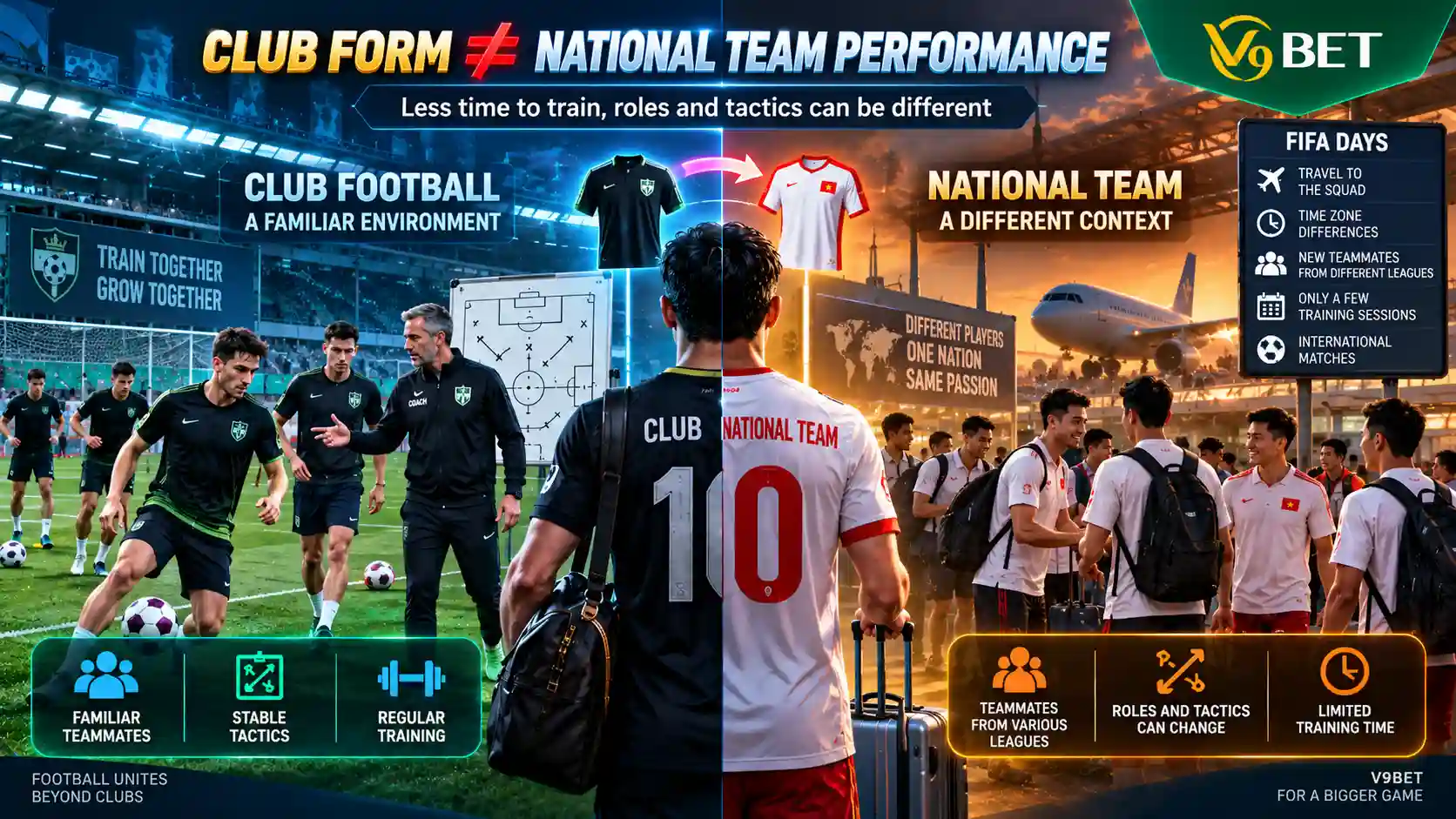
The difference between club form and national team performance during FIFA international windows.
How to Distinguish Competitive Matches from the Traps of Friendly-Match Betting
Competitive matches generally have clearer motivations, but that does not necessarily make them easier to bet on. Friendlies can be more difficult because the actual objectives may lie beyond the final score: testing formations, giving opportunities to new players, assessing fitness, or preparing for a more important match a few days later. When players only look at FIFA rankings and reputation, friendly-match betting traps can emerge very naturally.
Read the schedule as a group of matches rather than analyzing each match separately. If a strong team faces a manageable opponent in the first match but has a more important fixture immediately afterward, the possibility of resting key players needs to be considered. The starting lineup may still look strong, but the amount of playing time given to the stars may not be extensive. This is a risk area for large handicaps and second-half betting markets.
The underdog in a friendly is not automatically worth backing either. A lower-rated team may make several changes at once, test a three-center-back formation, or call up young players with limited international experience. If you simply assume that "friendly matches usually lead teams to hold back," you may lean toward the underdog or the Under without considering whether both teams are actually using the match to test their attacking approach.
Read Motivation Through the Next Fixture
The gap between two matches, the venue, and the next opponent often reveal more than general pre-match statements. When a team has to travel a long distance after the first match, the coach has a reason to manage playing time early. If both matches are played at the same venue and there are enough days between them, the likelihood of maintaining the main lineup may be higher.
You should not infer the lineup from a single factor. A favorable schedule does not guarantee that the coach will field the strongest team; a congested schedule does not necessarily mean the entire lineup will be rotated. What you can do is mark the risks, wait for the team sheet, and avoid prices that no longer compensate for the uncertainty.
Interpret Coaches' Statements at the Right Level
Terms such as "experiment," "give opportunities," or "prepare for the future" are signals worth noting, not sufficient evidence to place a bet. A coach may experiment with one position while keeping eight or nine familiar players. Conversely, a statement about wanting to win does not mean the national team will play with the intensity of a knockout match.
The value of a press conference lies in details that can be verified: which players arrived late, who is not fully fit, which positions need to be tested, and what the objective of the international break is. General statements about fighting spirit should be treated as background information.
How to Read a National-Team Call-Up List Without Being Influenced by Reputation
A squad filled with star players can easily create the impression that a national team is bringing its strongest possible lineup, but anyone analyzing the odds should consider which players actually fit the team's style of play. Three famous forwards cannot solve a problem if the midfield lacks players capable of moving the ball through the pressing line. Similarly, a defense containing several players from major clubs can still struggle if they are not accustomed to the same distances and roles.
Divide the squad into the stable core, players competing for positions, and players called up for experimentation. The core indicates the team's level of stability; the other two groups show the potential range of changes. When several new players are concentrated in central positions such as center-back, defensive midfield, or goalkeeper, the operational risk is generally greater than when changes are made on one flank.
A player's club situation also needs to be interpreted in the right context. A player with limited playing time may lack match rhythm, but may sometimes be fresher than a teammate who has been playing heavily. A player who has recently changed clubs may be dealing with the pressure of adapting. A player who performs well in a three-center-back system may not necessarily perform the same way when the national team uses a four-man defense. Reputation cannot replace tactical suitability.
|
Question Before Assessing the Lineup |
Positive Signal |
Signal to Treat with Caution |
|
Is the goalkeeper–center-back–defensive midfield axis stable? |
Several players are accustomed to playing together |
Multiple new players in central positions |
|
Is the creative player in their preferred role? |
Positioned within their familiar area of operation |
Required to drop deep or play on an unfamiliar flank |
|
Does the striker have an appropriate supply of the ball? |
The midfield can create passes into dangerous areas |
Reliance on crosses or individual moments |
|
Have new players had enough time to train tactically? |
Joined early and have clearly defined roles |
Arrived late and must adapt immediately |
|
Can the substitutes maintain the team's structure? |
Substitution options with similar roles |
Substitutions fundamentally change the team's style of play |
Before confirming a pre-match selection, bettors should check the official lineup. The process described in reading lineups before placing bets is particularly useful during FIFA Days, when a small change at club level may simply be rotation, while a similar change at national-team level can sometimes reshape the entire system.
Lessons for Analyzing FIFA Days Through Travel Schedules and Fitness
Travel schedules do not automatically create a betting opportunity, but they can explain why two teams of similar quality may show different levels of intensity. Players from South America, Asia, or North America who play in Europe may have to take long flights, cross time zones, and have only a few full training sessions. The effects are often more visible in pressing, recovery runs, and decision-making late in the match.
Do not simply count the number of kilometers traveled. Look at where the players are coming from, when they joined the national team, whether the match is being played at altitude or in a particular climate, and whether the team has to fly again afterward. A national team whose players mostly play domestically may sometimes have a significant preparation advantage over an opponent whose squad is assembled from multiple leagues.
Fitness should also not be inferred from the most recent result. A team that won by a large margin may have expended significant energy through continuous pressing, while a team that lost may have deliberately conserved key players from an early stage. Data on minutes played, rest periods, and travel distances can provide a more reliable picture than an isolated scoreline.
When Does Travel Have the Greatest Impact on Live Betting?
The impact often becomes more visible after match intensity increases. If a highly rated team is expected to press strongly at the beginning but the distances between its lines quickly become stretched, this may indicate that its fitness or coordination is not meeting the plan. However, the first few minutes are not enough. You need to observe whether the pattern is repeated across multiple phases of play or is simply the result of one moment of lost concentration.
For live betting, the advantage is that you have already seen the lineup and the pace of the match. The disadvantage is that prices change quickly, which can make players act because they fear missing an opportunity. The article on the difference between live betting and pre-match betting provides a useful foundation for deciding when to act rather than assuming that waiting for live markets is always beneficial.
How to Read Asian Handicap, Over/Under, and First-Half Markets in National-Team Matches
Asian handicap markets during FIFA Days need to be considered alongside the level of certainty surrounding the lineup. If the market gives a famous team a deep handicap while the roles of its key players remain unclear, the risk is not necessarily whether the team can win the match, but whether it can win by enough to cover the handicap. This is a common example of "backing the right team but taking the wrong line."
For Over/Under markets, the label of "friendly" alone is not enough to conclude that a match will be open. A team experimenting with its attack may create more attacking situations but coordinate poorly; a team changing its defense may make mistakes, but the opponent may fail to take advantage of them. Players should assess chance creation, the speed of ball circulation, and the personnel in the attacking areas rather than making assumptions based on the competition label.
First-half markets can be relevant when both teams have reasons to approach the match cautiously or when the favorite typically needs time to establish its structure. However, if the weaker team starts with a high press to create a surprise, the early pace can be faster than expected. Choosing the first-half Under simply because it is a national-team match is not a sufficiently strong argument.
|
Market Type |
Data to Prioritize |
Common Trap |
When to Wait |
|
Asian Handicap |
Lineup, motivation, and ability to win by a sufficient margin |
Backing the favorite because of its reputation |
When the handicap is deep but key players are not confirmed to play |
|
Over/Under |
Attacking structure, chance quality, and substitution patterns |
Associating friendlies with Over or Under based on intuition |
When it is unclear whether the teams are testing their attack or defense |
|
First Half |
Approach to the opening phase and time needed to establish the system |
Assuming the stronger team will dominate immediately |
When players arrived late or a new formation is being tested |
|
Live Betting |
Intensity, player distances, areas of control, and clear chances |
Chasing price movements |
When the first few minutes are too noisy or the match pattern is still unclear |
Odds movements should also be read as market signals, not as certain predictions. Prices can change because lineup information has been leaked, money is concentrated on one side, or bookmakers are rebalancing risk. If the reason cannot be identified, chasing a price movement may simply mean taking a less favorable price.
Signs That the Favorite Is Overpriced
The favorite is often pushed higher in the market when three factors come together: a big-name reputation, a recent high-profile result, and an opponent receiving little media attention. However, betting markets are concerned with the actual gap between the teams in that specific match, not the number of followers or brand value. A strong team can win 1-0 and still cause those backing a deep handicap to lose their bet.
The first warning sign is a growing handicap while the underlying information has not improved accordingly. If the lineup has not been confirmed, the travel schedule is unfavorable, and the coach has clearly indicated an intention to experiment, continued movement toward the favorite may reflect public sentiment more than a newly established advantage.
The second sign is a gap between individual quality and the ability to create chances. A team with many stars but slow build-up against a low defensive block may struggle to win by a large margin. If the midfield lacks players who can carry the ball forward or the striker has to drop too deep, high possession does not necessarily translate into clear chances.
The final sign is the bench. National-team matches often have periods where substitutions disrupt the rhythm of play. If the backup options are young, inexperienced, or stylistically different, the favorite may lose pressure at the moment they need another goal to cover the handicap.
When to Enter Pre-Match Markets and When to Wait for Live
Pre-match betting is more suitable when the core information is clear and the current price remains reasonable. For example, the nature of the match, the squad framework, the travel schedule, and the roles of key players can all be confirmed. There is no need to wait for live play simply to watch the opening minutes if waiting could cause a favorable price to disappear.
Conversely, it may be better to wait for live play when the uncertainty lies in how the team operates. The lineup may look strong on paper, but it may not yet be clear how aggressively they will press, where new players will position themselves, or whether the home team intends to control possession or concede the initiative. Watching the first five to fifteen minutes can help answer these questions, provided the player does not rush to conclusions based on an early shot or a few corners.
A practical principle is to decide in advance what you need to see. If considering the favorite, you need to see them consistently getting the ball into dangerous areas, winning the ball back effectively, and maintaining their distances. If considering the Over, you need to see clear chances being created from the structure rather than only from random mistakes. If the signals are not there, do not bet. This approach prevents opening the match and then looking for reasons to choose any side.
|
Situation |
Lean Toward Pre-Match |
Lean Toward Waiting for Live |
|
Lineup and key player roles are clear |
Yes |
|
|
New formation or many new players |
|
Yes |
|
Current price still has a margin of safety |
Yes |
|
|
Intensity needs to be verified after a long travel schedule |
|
Yes |
|
Market is moving but the reason is unclear |
|
Yes |
|
Friendly match with an unpredictable substitution plan |
|
Yes |
On V9Bet, players can monitor pre-match and live betting markets as the match develops. Regardless of which section is used, the principle remains the same: only choose markets you understand, check the settlement rules, and do not assume that features or options will be the same for every match.
How to Manage Your Bankroll When Betting on National Teams on V9Bet
FIFA Days have a dense match schedule, but the quality of available data is uneven. A reasonable bankroll approach is to reduce the amount allocated to matches with a high level of uncertainty rather than increasing the number of bets simply because many well-known teams are playing. The funds allocated for an international window should be separated from your living expenses and capped before the first match.
Suppose you allocate one million VND for the entire match period. Do not treat that as money that must be used in full. You can keep most of the bankroll unused and allocate only a small portion to matches where sufficient information is available. If a match does not meet your conditions, leaving the money unbet is still a better outcome than forcing a decision.
After a losing bet, the stake on the next match should not be increased simply to bring the account back to its starting point. The next match has its own data and has no responsibility to make up for the previous one. This approach to bankroll management is particularly important during a FIFA Days sequence, when matches across multiple time zones can create the feeling that there is always another opportunity to recover losses.
Those who want to build a disciplined framework can refer to the article bankroll management through the 2026 World Cup. The key lesson is not a fixed betting percentage, but how to distinguish between bankroll allocation, risk level, and the quality of information before each decision.
FIFA September Match-Day Analysis Process
In the morning, classify matches according to their nature and level of interest. Official matches with clear motivation should be prioritized for research; friendlies or matches involving too many new players should be marked for further observation. This is a filtering step, not yet the time to choose a side.
Before kickoff, update the squad list, starting positions, travel schedule, and information from official press conferences. Compare the latest information with the current market price. If the price has already moved too far away from the range you consider reasonable, skip it rather than regretting the previous price.
During the match, focus only on the signals identified in advance: team spacing, ball-winning areas, chance quality, fitness, and how the two full-backs provide support. Do not use possession statistics or shot counts in isolation. Ten low-danger long-range shots may be less valuable than two clear one-on-one chances.
After the match, record the reason for the bet and what actually happened. Do not record only whether it won or lost. A well-reasoned selection can still lose because of an event, while a winning bet due to a late goal is not necessarily a decision worth repeating. Keeping such a record helps build experience in analyzing FIFA Days over time.
Mistakes That Cause Players to Lose Their Edge the Fastest
The most common mistake is treating the FIFA ranking as an absolute ranking of team strength. Rankings are useful for establishing long-term relative strength, but they do not fully reflect today's lineup, venue, motivation, or tactical matchup. A large ranking difference does not necessarily mean that the handicap always offers value.
Another mistake is betting too early because of fear that the line will change. A good price only matters when the underlying assessment is good. If lineup information is decisive, accepting a later price can sometimes be more reasonable than taking on uncertainty too early. Conversely, there is no need to wait for the lineup if the selection is based on a confirmed factor and the price provides a sufficient margin.
Another mistake is applying the same assessment to multiple markets. Believing that the favorite will win does not mean you should simultaneously back the handicap, the Over, and the first-half market. Three bets may depend on the same scenario; if that scenario is wrong, the risk is multiplied rather than diversified.
Finally, there is chasing live bets. An early goal, red card, or VAR decision can cause emotions to rise sharply. If you can no longer read the match or the price is moving too quickly, leaving the betting market is a valid choice. FIFA Days involve many matches; no match requires you to place a bet.
FAQ About Analyzing FIFA September 2026 Betting Odds
Are all FIFA Days matches in September 2026 friendlies?
No. The nature of each match depends on the relevant confederation and the schedule of each national team. Europe has the UEFA Nations League, while other regions may hold qualifiers, regional Nations League matches, or friendlies. Check the competition's and federation's official websites before assessing motivation.
Should you always back the underdog in friendly matches?
No. Friendlies increase uncertainty but do not automatically favor the underdog. The weaker team may also experiment with its defense, call up many new players, or lack organization. Only consider the underdog when the handicap, lineup, and approach provide a reasonable margin.
Why can a strong team win while those backing the handicap still lose?
A handicap requires the strong team to win by a sufficient margin or meet the settlement conditions of the specific line. If they win narrowly while giving a deep handicap, the assessment that they would win may be correct while the handicap selection is still wrong. This is the difference between predicting the result and pricing the betting side.
How long should you consider a player's club form?
There is no single timeframe that suits every situation. Recent minutes played, tactical role, and suitability to the national team should generally be prioritized over a simple sequence of goals. Early-season data often comes from a small sample, so it needs to be considered in context.
Is the official lineup enough to decide whether to bet?
Not necessarily. The lineup shows who is starting, but it does not guarantee the intensity, tactical structure, or substitution plan. If the uncertainty lies in how the team will play, waiting for a few minutes of live action may be more appropriate.
Should you bet on multiple matches to diversify risk?
Do not confuse the number of bets with risk diversification. If multiple bets are based on the same tendency to back strong teams, the risk remains concentrated. Increase the number of matches only when each selection has an independent rationale and the total amount staked remains within the predetermined limit.
Is a last-minute odds movement a certain sign of lineup information?
No. Odds can change because of lineup news, money flows, or market-balancing activity. If you cannot identify a reliable reason, treat the movement as a signal that needs to be checked rather than as an instruction to follow.
Expert Conclusion
Analyzing FIFA September 2026 betting odds does not begin with asking which team is more famous. It begins by identifying what type of match it is, where the national teams are in their post-World Cup cycle, how well the players have recovered and integrated, and how much expectation is already reflected in the current price.
Practical advantages often come from less glamorous details: flight schedules, the number of training sessions, the stability of the central spine, plans for the next match, and the ability to maintain structure after substitutions. When these factors remain unclear, waiting for the lineup or observing the live match can be appropriate. When the price is no longer attractive, skipping the bet is preferable to trying to prove the original assessment.
V9Bet national-team betting should be treated as a limited form of entertainment. Check the conditions of each market, set a bankroll limit before the match, and stop when decisions begin to be driven by the desire to recover losses. A well-managed FIFA Days period is not one with the most bets, but one in which the player maintains discipline when facing matches they do not understand deeply enough.
Schedule verification source: UEFA Nations League and match schedules published by the federation of each national team. Schedules, lineups, and betting markets may change; check again shortly before kickoff.